Thursday, June 1, 2017

Gharib, Ali. “Center for American Progress Hosts Netanyahu as Leaked Emails Show Group Censored Staff on Israel” (12 Nov 2015) Democracy Now.


  NERMEEN SHAIKH: Just eight months ago, U.S. and Israeli relations were said to be at their lowest point in decades. In early March, Israeli Prime Minister Benjamin Netanyahu came before Congress in an unprecedented, and ultimately unsuccessful, attempt to kill the nuclear deal with Iran. Then, several weeks later, Netanyahu was re-elected after warning of a high turnout of Arab voters and vowing to prevent the establishment of a Palestinian state. That prompted criticism from the Obama administration and even talk for the first time of the U.S. no longer blocking U.N. measures critical of Israeli settlements and the occupation.
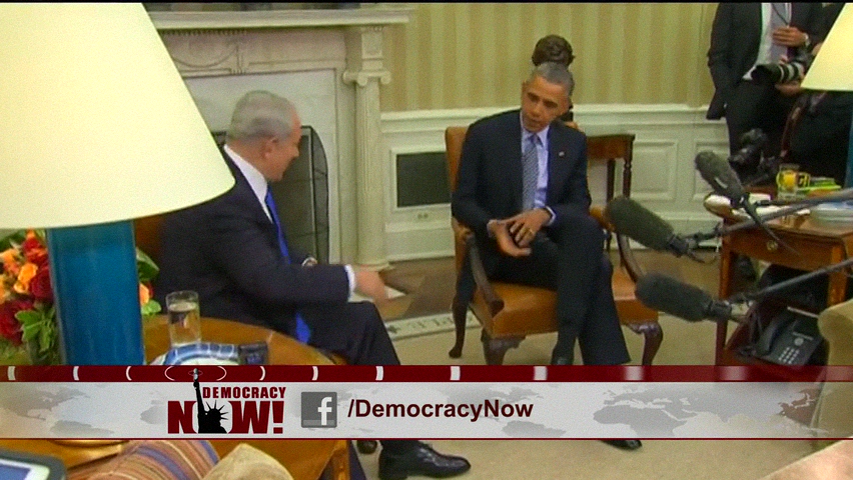
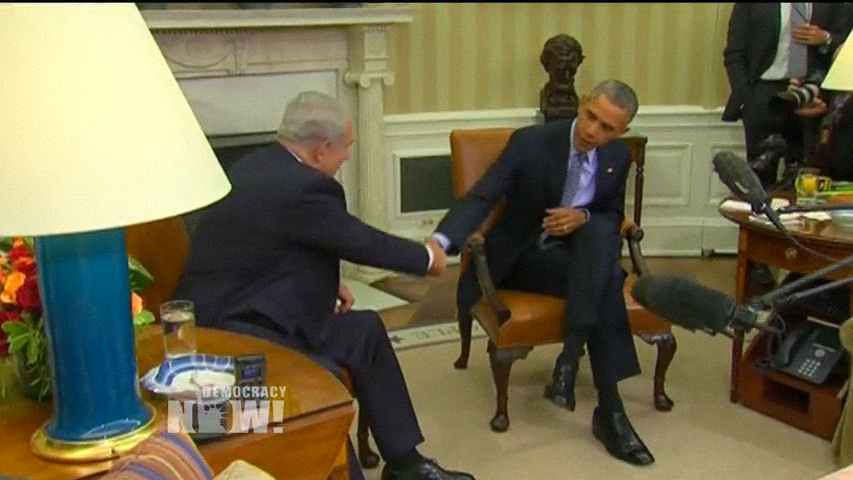
  But those expecting a confrontation when Netanyahu returned to Washington this week were mistaken. Instead, President Obama and Netanyahu held what all sides agreed to be cordial talks on increasing U.S. military aid to Israel. Netanyahu reportedly requested a record $5 billion in annual U.S. military aid, an increase over the $3 billion the U.S. already provides. If Obama had any concerns about Israel’s occupation of Palestinian land and its continued illegal settlement activity, he did not share them publicly.
   Addressing the Jewish Federation of North America, Netanyahu praised his talks with Obama.

  PRIME MINISTER BENJAMIN NETANYAHU: I had a very good meeting with President Obama at the White House, and I deeply appreciate his commitment to bolster Israel’s security at the time when the Middle East is becoming more dangerous than ever. And I also want to say that we are sharing so many things. The United States is giving indispensable help to Israel—indispensable—but Israel is returning that assistance almost on a daily basis in intelligence and in many other things.

  AMY GOODMAN: Despite the high praise, there are signs the tension still remains. Ahead of Netanyahu’s visit, Israel moved to greenlight the expansion of Israeli settlements in the West Bank with 2,200 new housing units. The move recalled a similar act by Netanyahu just before a visit to Israel by Vice President Joe Biden in 2010.
  A few days before the Israeli prime minister arrived in Washington, he appointed Ron Baratz to become head of public diplomacy and media at the prime minister’s office. In a Facebook post in March, Baratz described Obama as, quote, “the modern face of anti-Semitism in Western and liberal countries.” Last year, Baratz said Secretary of State John Kerry had the mental capacity of a 12-year-old.

  NERMEEN SHAIKH: While President Obama was publicly silent on the occupation during Netanyahu’s visit, Hillary Clinton wrote an article for The Forward headlined “How I Would Reaffirm Unbreakable Bond with Israel—and Benjamin Netanyahu.”


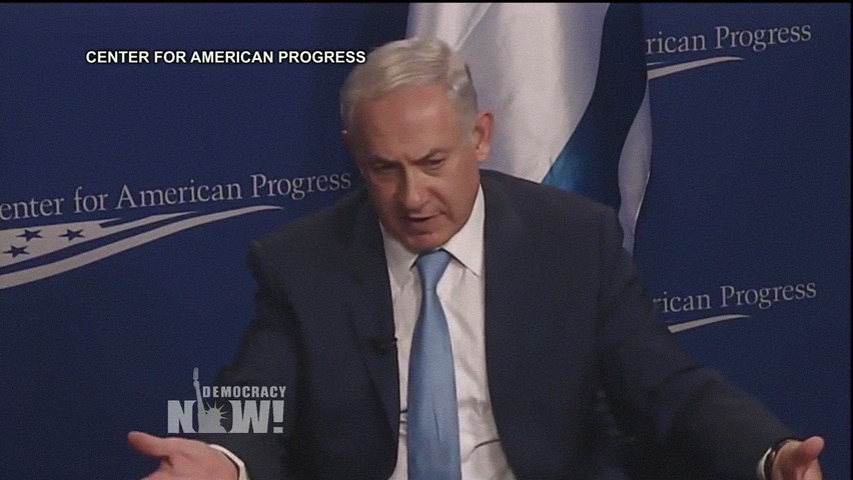
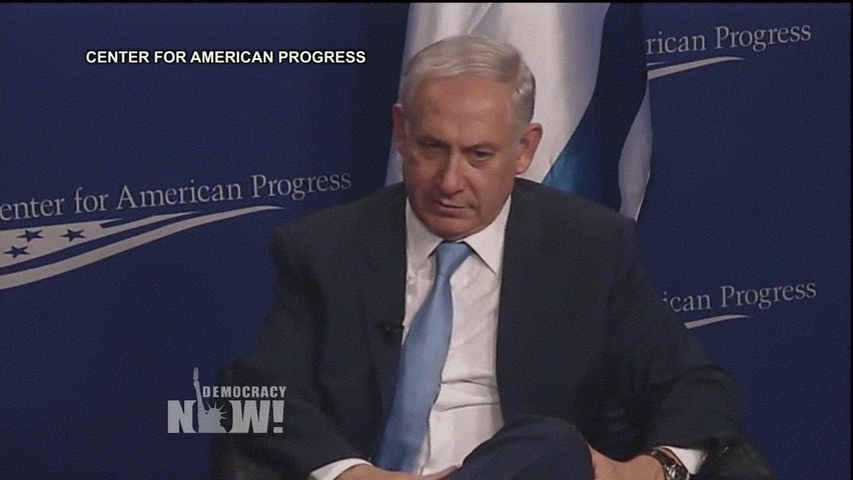
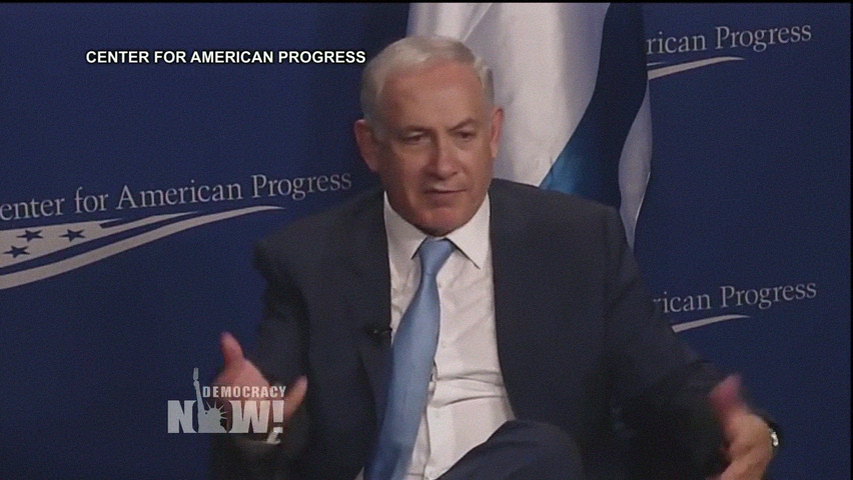
  Meanwhile, the Center for American Progress, a leading progressive group with close ties to both Clinton and Obama, held an event this week hosting Netanyahu in Washington. That decision reportedly prompted a revolt from some staffers, angered that a liberal group would give Netanyahu a platform. In his opening remarks at the event, Netanyahu told attendees he wanted to speak to a progressive audience.

  PRIME MINISTER BENJAMIN NETANYAHU: I’d like to talk to a progressive audience about progressive values. I think that Israel is at the very least misunderstood, because I think that if you look at all the values and all the rights that you deem important—I’m talking about the rights of women or the rights of gays or the rights of minorities, the rights of Arabs, the rights of Jews, the rights of people—these are enshrined in an imperfect society—Israel is not perfect, I don’t know any society that is—but one that is facing incredible odds with incredible successes. And it safeguards those values in a very, very troubled area.

  AMY GOODMAN: Israeli Prime Minister Benjamin Netanyahu, speaking to the Center for American Progress.
  Netanyahu’s appearance came just days after a new controversy over the group’s alleged censoring of writers critical of Israel. Newly leaked emails from 2011 and ‘12 published by The Intercept show the Center made key editorial decisions—including editing articles, silencing writers and backing off criticism—at the behest of influential groups who backed Israeli government policies.
  Center for American Progress representatives were not available to join us today on the show, and they sent us a statement instead, saying, quote, “CAP believes we need to engage with people we don’t agree with. Tuesday’s forum covered a broad range of issues including the prospects for peace, West Bank settlements, the Prime Minister’s past remarks, and settler violence. By having the Prime Minister with us, we sought to elevate the quality of the debate about U.S.-Israeli relations after several years of tension,” they wrote.
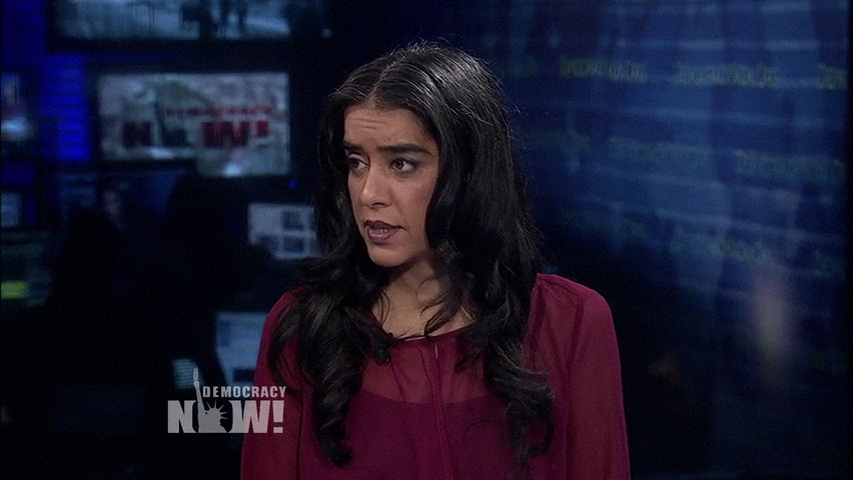
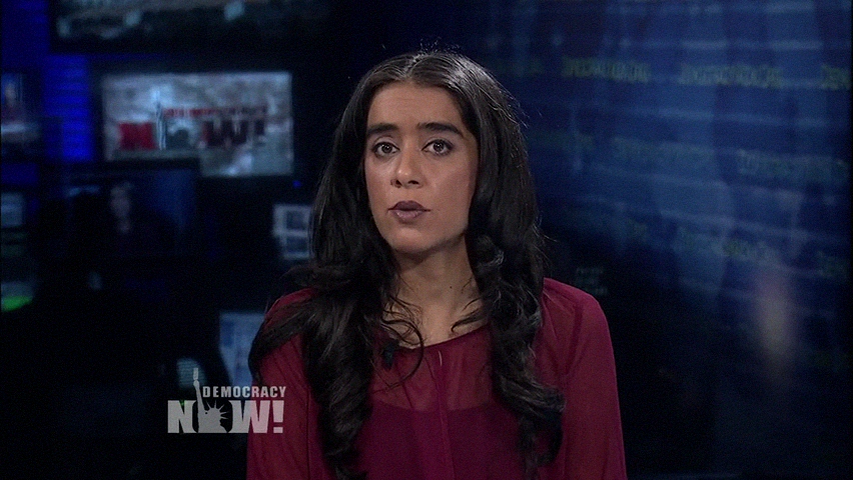
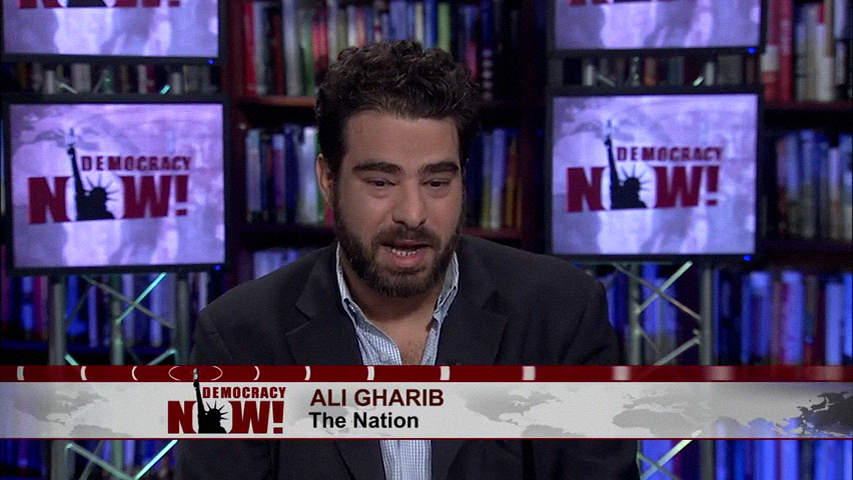
  For more, we’re joined by a guest who experienced the censorship firsthand, he says. Ali Gharib is with us, contributor to The Nation magazine, former staffer at the Center for American Progress. One of Ali Gharib’s articles for the Center, he said, was censored after complaints that the Center president, Neera Tanden, a Clinton loyalist who served under President Obama—Ali Gharib was told firsthand not write articles [critical] of leading pro-Israel groups, such as AIPAC.
  We welcome you to Democracy Now! Before we get into Netanyahu speaking before the Center, can you talk about these allegations you’ve made? You worked for the Center at that time that these leaked emails come from, that The Intercept got a hold of?
  ALI GHARIB: Yeah, I mean, the basic story was that we got attacked by a group of right-wing, pro-Israel advocates over a period of several months, and instead of kind of standing behind our work, CAP’s leadership turned around and went to the same groups that were attacking us, and in an attempt to curry favor with them, said, “Well, we’ll tamp down these criticisms of Israel.” And as you said, I—
  AMY GOODMAN: How do you know they said that?
  ALI GHARIB: Sorry?
  AMY GOODMAN: How do you know they said, “We’ll tamp down these...”?


  ALI GHARIB: Well, it was clear in the emails that were leaked that they had been going to groups like AIPAC and saying, “We’re working on this problem.” And then, you know, I sat in an editorial meeting where it was made absolutely clear that AIPAC—criticizing AIPAC was not on the menu, and, less specifically, criticizing Jewish groups that were advocating for Israel was something that we weren’t supposed to do in the pages of the CAP products we were putting out.
  NERMEEN SHAIKH: And is it the case that there was a special editor who was designated to look at all the material that was being written about Israel?
  ALI GHARIB: Yeah, we had a minder who—you know, I was looking at the Center’s blog, ThinkProgress, and we had a minder who would take all of our posts before publication to the executives upstairs whenever the subject was Israel, and also, in many cases, Iran. And then, you know, one of the posts that you were talking about, Amy, that got censored after publication had been a post that was about an Islamaphobic film that was being shown at NYPD trainings, and we wrote an article pointing out that the people behind this film were a group of an evangelist Orthodox Jewish group that was involved in promoting West Bank settlements and had a long history of Islamophobia. And that was the post that—you know, it didn’t go through the normal channels because it wasn’t about Israel, it was just that the people who happened to be putting out the movie were Israelis. And that was the one that then elicited complaints from pro-Israel advocates and was cut down after publication to remove any references to Israel.

  NERMEEN SHAIKH: Well, I want to turn to one of the emails leaked to The Intercept. Writing in January 2012 to some of her employees, CAP President Neera Tanden said, quote, “I just got off the phone with Ann Lewis who continues to be adamant that a real problem is that our blog seems anti-Israel because—and I’m just reporting in—while it seemingly takes every opportunity to criticize Israel, it takes no opportunity to actually say Israel is doing the right thing. She said she went through even the last few weeks and saw this bias.” Tanden went on to say that Ann Lewis, who was a close aide to Hillary Clinton, insisted that, quote, “we’re going to continue to have a problem until our blog seems like it’s not anti-Israel. I tried to discuss Israel, v. the Israeli govt.’s policies. But she ... was not really buying it.” So could you talk about who Ann Lewis is and why the CAP leadership was concerned about her opinions of the CAP blog?
  ALI GHARIB: Well, Ann Lewis is sort of a Democratic apparatchik who, since that time, since 2011, 2012, when all this happened, has joined The Israel Project, which is a right-wing, pro-Israel advocacy group that’s headed up by a fellow named Josh Block, a former AIPAC spokesman, who also was the one who launched the attacks against us, calling us anti-Semites and trying to, you know, curtail our message on Israel. And I don’t know what was going on in Neera Tanden’s head, but I presume they met somewhere in Clintonland. They were both Clinton aides, and they’re both considered Clinton loyalists. And that line of communication, presumably, remained in—
  AMY GOODMAN: When you say Clinton, you’re talking about?
  ALI GHARIB: Bill and Hillary Clinton, I think. They both—Tanden worked for Hillary’s campaign the first time around in 2008, and Ann Lewis was close to the Clintons when Bill was president, as well.
  AMY GOODMAN: We’re going to break, and when we come back, we’re going to talk about Netanyahu coming to the Center for American Progress. ThinkProgress wrote “10 Falsehoods That Netanyahu Told During His Appearance at CAP.” ThinkProgress, you talk about it in the past as being the blog of the Center—
  ALI GHARIB: Yeah.
  AMY GOODMAN: —but it is separate now?
  ALI GHARIB: Yeah, I think they’re staking out some editorial independence. I mean, that becomes clear with these sorts of posts that they’re doing. You know, I can’t speak to whether they have restraints now on their work, but they certainly did when I was there.
  AMY GOODMAN: Ali Gharib is a contributor to The Nation, former national security reporter for ThinkProgress, a project of the Center for American Progress Action Fund. His most recent piece is headlined “Dissent Breaks Out at the Center for American Progress over Netanyahu’s Visit.” We’ll be back with him in a minute.

  [break]


  AMY GOODMAN: This is Democracy Now!, democracynow.org, The War and Peace Report. I’m Amy Goodman, with Nermeen Shaikh.

   
  NERMEEN SHAIKH: I want to ask about some of the objections raised by Center for American Progress staff last week regarding the invitation to Netanyahu. In the statement they read aloud, they wrote, quote, “there’s something distinctly not bold or progressive about referring to the Prime Minister as ‘someone with whom we disagree’ or ‘someone who said some terrible things.’“ They went to say, quote, “this is a person who continues to defend the deaths of over 2000 people—many of them children—last summer alone. What do we call a disagreement of that magnitude? A thing that terrible? Would we bring other leaders to this institution who had committed similar crimes?”


  Meanwhile, Winnie Stachelberg, CAP’s executive vice president for external affairs, told Foreign Policy magazine that, as a think tank, quote, “we believe we need to be open in engaging with people we don’t agree with.” She also pointed out that the Israelis initially reached out to CAP and that in the past CAP has been, quote, “highly critical of the prime minister for only dealing with the right.” She went on to say, quote, “Had we said no [to Netanyahu], there would be no public forum where he would’ve been asked tough questions, and quite frankly, we would’ve been hypocritical.”


  So, Ali Gharib, can you comment on what the CAP executive vice president for external affairs said and whether, from your assessment of the event, the questions asked were critical of Netanyahu?
  ALI GHARIB: Well, you know, I think that there’s a hypocrisy there. You know, it’s tough from where I’m sitting, because of this incident that happened a few years ago, to have some of the same CAP executives that were involved in that saying that now they favor an open debate, after they censored our writing. But, you know, I think that their record speaks for themselves—itself. There’s no—you know, none of these groups would host proponents of boycott, divesting and sanctioning Israel, even though that’s a growing grassroots movement. And granted, you know, that’s different than a head of state, but still, it’s about the—if it’s about the free debate of the ideas, that’s an idea that’s growing and is increasingly important. And so, I don’t think that they really want just an open debate with all comers. I think that it is sort of pandering to a particularly powerful political force in the United States.
  AMY GOODMAN: Let’s go to the Center for American Progress event with the Israeli prime minister, Netanyahu on Tuesday. CAP President Neera Tanden questioned him about a comment he made during the recent elections in Israel.

  NEERA TANDEN: One incident that really did strike a nerve with many progressives was statements made during the recent election. And I just want to quote where it was said. You said, “Arab voters are coming out in droves to the polls.” And people were a little taken aback by that. So what do you say to progressives in the United States who worry about comments like that and what it means for an inclusive Israel?
  PRIME MINISTER BENJAMIN NETANYAHU: Well, I think that these—this statement, as it was said, was wrong, because, first of all, you should know that Arabs voted for me. And I welcome that. In fact, you may check this, but I think they voted for me in considerably larger numbers than they voted for the Labor Party. I was not referring to going to vote. I was speaking about a specific list that was opposed. But it shouldn’t have been said. A few days after the election, I called in the Arab leaders and—Arab leaders to the prime minister’s residence. And I said, “I’m the prime minister of each of you. And I—I don’t want that statement to go uncorrected.” I corrected it. I made sure that they understand it.

  AMY GOODMAN: That’s Israeli Prime Minister Benjamin Netanyahu. Your response, Ali Gharib?
  ALI GHARIB: Well, you know, even that answer has some problems with it. He says that despite his statement that Palestinian citizens of Israel voted for the Likud in larger numbers than Labor—and that’s just not true. Noam Sheizaf did an analysis on +972 Magazine, the lefty Israeli blog, that—you know, it wasn’t a comprehensive analysis, because the actual statistics can be tough to divine, but he pointed out that in the Arab municipalities that are Palestinian cities within Israel, Likud had been beat something like three to one by Labor in its best showings. And so, you know, even that, the guy just spits out falsehoods. And I think that speaks to the fact that Neera Tanden wasn’t the right person to conduct this interview, because she’s not prepared with that sort of information. She doesn’t know the issues well enough to be able to respond when Netanyahu brings these falsehoods.
  AMY GOODMAN: He was also questioned during the Center for American Progress event on Tuesday about Gaza.

  PRIME MINISTER BENJAMIN NETANYAHU: Israel went through the book. It went by the book. It left Gaza to the last square centimeter. It took away all the settlements, skip freeze, just took them apart. It even disinterred people from their graves, handed the keys over to Abu Mazen, who promptly lost it to Hamas, even though they were only 3,000-strong then and he had 15,000 troops. They kicked him out.

  AMY GOODMAN: Your response, Ali Gharib?
  ALI GHARIB: Yeah, I mean, that’s just not true, either. Every international authority in the world considers Gaza occupied. And the reason for that is because Israel controls its borders and reserves the right to make incursions there. Just because there aren’t settlements and aren’t like checkpoints on Gazan roads doesn’t mean that it’s not militarily occupied and that the residents there aren’t subjugated by Israeli military power. I mean, even—Israel doesn’t make new declarations of war every time it starts these flares-up of violence in Gaza. It does it under the authority that it has as an occupying power.
  NERMEEN SHAIKH: Well, Netanyahu was also asked about settlements, and this was his response.

  PRIME MINISTER BENJAMIN NETANYAHU: There have been no new settlements built in the last 20 years, and even before I became prime minister the first time. The additions are in existing communities. The map doesn’t materially change. By the way, google this, because this is just repeated ad nauseam, so it assumes the cachet of self-evident truth that we’re gobbling up land and so on. We’re not gobbling up land, because it doesn’t take up any land. I mean, the total amount of built-up land is just a few percent. And the addition, if you look at it over time, the addition, it’s got to be a fraction of a percent, maybe one-tenth of 1 percent, two-tenths of 1—maybe I’m wrong. Maybe three-tenths of 1 percent. That’s the land that has been gobbled up. ... The settlements are there. The growth in the settlements does not materially affect the potential map for peace. And third, I think that it’s an issue that can be resolved, but I don’t think it’s the core issue. The reason it’s not the core issue is that it wasn’t a core issue in Gaza, either.

  NERMEEN SHAIKH: Ali Gharib, your comments on what Netanyahu said about the status of settlements?
  ALI GHARIB: Yeah, I mean, again, it’s just like obfuscation. He doesn’t—he just elides the main points. The settlements are clearly growing. They’re growing in population. They’re growing in size. And when Netanyahu says there hasn’t been any new settlements, his government took steps just this very week to legalize two outpost settlements, which are settlements that are considered illegal even by Israeli law. And yeah, I mean, the settlements have grown in population so much over the past 20 years. You know, if you look back at the evacuation of settlers from Gaza, that was about 5,000 or so settlers. And now you’ve got hundreds of thousands living in the West Bank. The idea that they can just be extricated without an issue and it’s not a problem and the settlements aren’t an obstacle to peace is totally bogus. And everybody knows it in the world, except for Netanyahu.


  NERMEEN SHAIKH: Well, I want to go back to the op-ed in The Forward written by Democratic presidential hopeful Hillary Clinton last week. In the piece headlined “How I Would Reaffirm Unbreakable Bond with Israel—and Benjamin Netanyahu,” Clinton wrote, quote, “I have stood with Israel my entire career. ... As president, I will continue this fight.” She goes on to say, quote, “I will do everything I can to enhance our strategic partnership and strengthen America’s security commitment to Israel, ensuring that it always has the qualitative military edge to defend itself. That includes immediately dispatching a delegation of the Joint Chiefs of Staff to meet with senior Israeli commanders. I would also invite the Israeli prime minister to the White House in my first month in office.”
  In July this year, Clinton also wrote a letter to the billionaire Israel supporter Haim Saban, seeking his assistance in countering the Boycott, Divestment and Sanctions movement, or BDS, calling it, quote, “the latest attempt to single out Israel on the world stage,” adding that “we’ve seen this sort of attack before, at the UN and elsewhere.”


  So, Ali Gharib, could you comment on Hillary Clinton coming out so openly in defense of Israel?
  ALI GHARIB: Yeah, I mean, she’s clearly trying to draw a contrast to Obama, and it seems pretty obvious that a big part of that issue is donors like Haim Saban. I mean, Saban was—is a billionaire and is a Democratic mega-donor, but was notably cool on Barack Obama, and as he said himself, over Israel. He’s got very hawkish views on Israel. And so it seems obvious that this is just kind of pandering. You know, in Clinton’s op-ed, there was not a word about the occupation. And the only appearances Palestinians made were as knife-wielding terrorists. And, you know, no mention of their basic rights and how their basic rights are being trampled on by the Israeli occupation. So, you know, this is like going—taking us back a few steps in the changing discourse about Israel in this country.
  AMY GOODMAN: Well, Ali Gharib, we want to thank you very much for being with us, contributor to The Nation magazine, former national security reporter for ThinkProgress. We will link to your piece and also to the ThinkProgress piece, “10 Falsehoods That Netanyahu Told During His Appearance at CAP.”
  ALI GHARIB: They deserve credit for that piece.
  AMY GOODMAN: This is Democracy Now!, democracynow.org.

Tuesday, May 30, 2017

McClintock, Michael. Instruments of Statecraft: U.S. Guerilla Warfare, Counterinsurgency, and Counterterrorism, 1940-1990. NY: New York, Pantheon Books, 1992. Contents/About This Project/Introduction.


  About This Project
  Introduction
  PART ONE: Cold War and Special Warfare
1.       Interest, Intervention, and Containment
2.       Toward a Doctrine of Special Warfare
3.       The Legacy of World War II
4.       Toward a New Counterinsurgency: Philippines, Laos, and Vietnam
5.       Waging Unconventional Warfare: Guatemala, the Congo, and the Cubans
  PART TWO: Camelot and Counterinsurgency
6.       The Kennedy Crusade
7.       The Apparatus in the Field
8.       Edward Geary Lansdale and the New Counterinsurgency
9.       The Heart of Doctrine
10.   Counterterror and Counterorganization
11.   Tactical Totalitarianism
12.   The Problem of Ideology
  PART THREE: Special Warfare and Low-lntensity Conflict
13.   The Carter Years
14.   Morning in America and the Special Warfare Revival
15.   The Special Forces’ Buildup
16.   The Middle East Calls the Shots
17.   Watching the Neighbors: Low-Intensity Conflict in Central America
18.   An Un-American Way of War
  Epilogue

  About This Project
  Instruments of Statecraft: U.S. Guerilla Warfare, Counterinsurgency, and Counterterrorism, 1940-1990 was published in 1992 by Pantheon Books, a division of Random House, Inc.
  Informed by recently declassified and previously unpublished documents, Instruments of Statecraft is an authoritative study of American covert, unconventional warfare waged against ideological adversaries, from the Truman administration up to the recent war in the Persian Gulf.
  Since World War II, assassination, sabotage, kidnaping, torture, the overthrow of foreign governments, and other terroristic activities have been intrinsic to our national defense policy. These have been justified time and again as necessary to combat communist insurgency and, more recently, terrorism-as the only effective response to the barbarism ascribed to, or projected onto, our enemies- be they Sandinistas or the PLO.
  So it is that America has maintained forces -including the OSS, the CIA, the Green Berets, and the Delta Force-that have specialized in dirty warfare with impunity, in Nicaragua, Lebanon, Laos, Vietnam, the Philippines, Afghanistan, Guatemala, Africa, Cuba, Central America, and Greece, among other places.
  Michael McClintock gives a fascinating and alarming expose of the dark side of American foreign policy, while examining its tactical roots-from the pronouncements of Clausewitz and Raymond Aron, to its ideological basis in the Monroe Doctrine, Theodore Roosevelt’s “Big Stick” foreign policy, and Woodrow Wilson’s post-colonialist crusade.


  Michael McClintock was born in Ohio and holds a bachelor’s degree from Ohio University and a master’s degree in political science from the University of Wisconsin. He has been a human rights monitor for the past sixteen years, traveling extensively throughout all of Central America, as well as in Bolivia, Venezuela, Brazil, Thailand, and the Philippines. He is the author of The American Connection, a study of U.S. covert activities in Latin America.


  Introduction
  The conduct of foreign affairs by the United States in the latter half of this century has a military dimension that can be seen only obliquely. The awesome military machine that emerged with the Cold War was designed largely for deterrence, for a war never meant to happen. It served, too, for occasional, limited, conventional wars; lesser conflicts; and shows of force. But the manpower and armaments of this behemoth were only a part of the United States’ military response to the Cold War. Another, nearly opaque, military dimension entailed what has been variously referred to as secret, special, unconventional, or political warfare. This hidden dimension became the chosen instrument for permanent military action below the threshold of full-scale war or open intervention—another kind of war, that was waged continuously behind the false peace of the post-World War II era.
  This secret warfare introduced a unique new element into foreign affairs and into the domestic arrangements of nations friendly to the United States. Its influence was most significant in the lesser theaters of the Cold War—including much of the Third World—where military answers to new global challenges were removed from public scrutiny. Through the efforts of the armed forces’ special warfare establishment and the Central Intelligence Agency, the military thread of the new warfare wound around and through the formalities of above-board international relations.
  The paramilitary covert operation became the occasional signpost of the secret war, deflecting attention from long-term policies or programs, from the unconventional side of America’s regular armed forces, and indeed, from the larger goals of American foreign policy. Responsibility for such operations was usually displaced to the CIA, which was neatly set apart from the regular armed forces—in public perception if not wholly in fact—while the military remained prudently in the shadows. The impact of the armed forces’ special warfare apparatus and doctrine was most telling, not in the record of American operations, but in the extent to which it influenced the attitudes, organization, and programs of American allies throughout much of the Third World during the Cold War.
  A fascination with special warfare, from guerrilla warfare to the subtleties of ideological indoctrination, was characteristic of U.S. foreign policy makers at the onset of the Cold War. Belief that the Soviets were masters of special warfare, wielding an instrument of great power helped shape our Cold War attitudes toward them while creating anxiety over whether the United States, constrained by its self-proclaimed virtue, could compete in a war without rules.
  Argument prevailed that this kind of war was best fought at two levels: through occasional use of overwhelming military power (e.g., Greece and Korea); and through uninterrupted use of the kind of unconventional methods of low-level conflict attributed to the Soviets. The guardians of the national interest concluded that the United States should respond to communist treachery in kind—fire against fire.
  The United States learned secret warfare from the experiences of World War II, from both its allies and its enemies. American officers were baptized in the fire of what seemed to be a new kind of war in enemy-occupied territories of both European and Pacific theaters. The tactics and attitudes they developed found ready application in the tensions of the postwar world. Officers who had operated with resistance movements were brought together to organize the new special warfare establishment. The Army Special Forces were developed to take American-style guerrilla warfare to nations under Soviet domination.
  The men who drafted the field manuals for the American guerrillas— or what they generally referred to as unconventional warfare—used as models, the guerrilla campaigns in the Philippines; the partisan movements in the Soviet Union and the Balkans; the experiences of emigres’ co-opted into American service, and former German officers. The Army’s secret review of the European partisan movements was assisted by ex-Wehrmacht officers who had taken part in their suppression; they were coauthors of reports that colored American views of the nature of guerrilla (and counterguerrilla) warfare for decades to come. A common view emerged that terror was an essential tool of both guerrillas and counterguerrillas. The American manuals and assorted training materials made explicit reference to the utility—indeed, the necessity—of its use from hostage-taking to selective assassination.
  The counterinsurgency era (the subject of Part Two) began with John F. Kennedy’s call for a radical reappraisal of U.S. special warfare. His fascination with the Special Forces and the idea of American guerrillas meshed neatly with his Cold War view that the small wars of subversion and insurgency on the periphery of the “Free World” posed the greatest challenge to our national security. In particular, Kennedy emphasized counterinsurgency’s use for political and economic reform. Chapter Eight profiles one of the President’s principal counterinsurgency advisers, Edward Geary Lansdale, who is known both for his advocacy of reform and “civic action” and for his pioneering role in the field of dirty tricks and psychological warfare.
  Until 1961, the purpose of the Special Forces was to train guerrillas, rather than combat them. In accord with Kennedy’s wishes, the military redefined counterinsurgency as a discipline of special warfare, departing from the pre-World War II concepts of counterinsurgency based on conventional tactics—i.e., occupation and administration. The unconventional dimension of counterinsurgency became an integral part of American Cold War doctrine. Counterinsurgency became a medium of the secret war directed against internal enemies wherever friendly governments were under threat of subversion or insurgency. These domestic campaigns were aspects of a larger war within which the United States also launched unilateral “guerrilla” operations (which often includcd air and naval support) to overthrow undesirable regimes. The crux of the new doctrine (set out in Chapter Nine), that the adversary was best fought with its own methods, was based as much on assumption as on fact, and proposed that we should become the “mirror image” of what we imagined the enemy to be.
  As terror was seen as integral to guerrilla tactics, the counterguerrilla would apply counterterror; guerilla organization (e.g., recruitment surveillance) would be mimicked by counterorganization. Counterorganization, taken to its extreme, could (and often did) cutrail placing hundreds of thousands of people under virtual totalitarian control. Which combined with the psychological warfare technique of ideological indoctrination, totalitarian potential could become reality. The consequences were most dramatic in countries where friendly governments uncritically adopted the American model on a massive scale.
  The end of the war in Vietnam was a watershed in the development of special warfare, both offensive (guerrilla operations) and, nominally defensive (counterinsurgency). (Part Three outlines the development of special warfare from the end of the Vietnam War to the last days of the Reagan administration.) Jimmy Carter’s human rights policy, which might have Ied to a radical reassessment of covert U.S. foreign policy, faltered and failed in the face of political pressure and the intransigence of the military and foreign-policy establishments. By 1980, the spirit behind the housecleaning of the CIA, which had begun with Carter, was superseded by measures strengthening the United States’ special operations potential and by open-ended commitments to secret wars in Central America, Afghanistan, and the Middle East.
  The real post-Vietnam revival of special warfare—as part of the new concept of “low-intensity conflict”—came with the Reagan administration. The rollback of perceived gains made by the Soviet Union, notably in Central America, was the centerpiece of foreign policy during his first term in office. The apparent American slippage in the Cold War was taken up as a challenge that would justify a newly aggressive pursuit of special warfare. (The rapid buildup of the United States’ special warfare apparatus and its role in planning for new wars on the periphery is outlined in Chapter Eighteen.)
  Developments in the Middle East during Reagan’s first term complicated the administration’s response to low-intensity challenges (see Chapter Sixteen). The loss of American lives, particularly the 246 Marines killed in Beirut, prompted a new direction in the White House’s action and a new vehemence in its rhetoric. Onto its crusade against the ideological enemy in Central America and the Caribbean was superimposed a campaign against international terrorism. In doing this, the Reagan administration broke with the reticence of past advocates of counterterrorism and openly espoused the logic of adopting terrorist methods to fight terrorists. Implying the legitimacy of a state’s turning to terror tactics as a utilitarian means to an end, the Reagan administration publicly extended the logic of covert counterinsurgency in internal conflicts to the sphere of international relations. Despite Reagan’s overwrought rhetoric about terrorism, there was evidence that the United States had, indeed, experimented in perpetrating the very kind of terrorism it claimed to oppose.
  The new commitment to special warfare was most amply and visibly manifest in Latin America and the Caribbean, from the Windward Islands to the wars in El Salvador and Nicaragua. The consensus of the special warfare experts then, as now, was that low-intensity conflict was intrinsically an “un- American way of war.” The substance of the United States’ doctrine for these unpalatable, dirty wars, however, was to reaffirm the logic of the 1950s. The special warfare establishment would do whatever was necessary to prevail in secret, political warfare. The United States could wage dirty wars with the best (or worst) of them.
  The events of the first three years of George Bush’s presidency— most notably the collapse of communism, the invasion of Panama, and the Gulf War—required an epilogue to this study. The end of the Cold War did not eliminate at a stroke the Cold War attitudes, ideology, and military doctrine that fuel the secret war on the periphery; there is little to show that the United States has modified its use of special warfare in any discernible manner. Even if it were to progressively do so, the legacy of decades of clandestine special warfare and its influence on foreign affairs will not readily dissipate. The United States’ Cold War doctrine and ideology remain particularly potent for the many “Free World” clients that have used them as a template with which to remodel their societies, political institutions, anal security systems into effective instruments of counterinsurgency. The overarching threat which once welded American special warfare into a cohesive and comprehensive program may be gone, but special warfare remains a principal instrument of low intensity conflict in the new world order.