Narrator: 1957. Ford launches the **. Russia sent
some dog into Space. Make-believe
gangster Humphrey Bogart dies. On Television, 20 million American see
real-life gangster, Vito Genevese, accused of being the head of the Mafia.


“Is it true that you’re the head of the Mafia in the
country?”
Genovese: “It is not. The true.”
“Sir, have you ever been in any way connected with
the Mafia?”
Genovese: “Never.” [Barack Obama.]


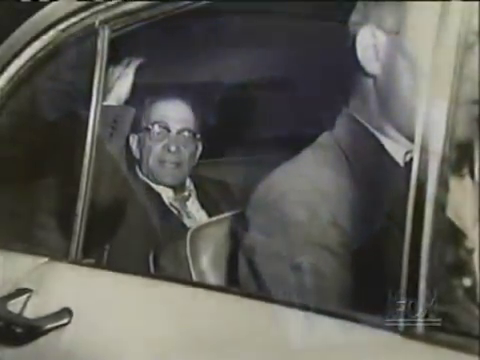
Narrator: Genovese is right. He is not the head of
the Mafia. Just wants to be. Number-two guy in the Luciano Crime family, he
makes his move. A grab for Power, the worst thing he could have done. Vito’s
first mistake, trying to whack the Family’s Prime Minister, Frank Castello.


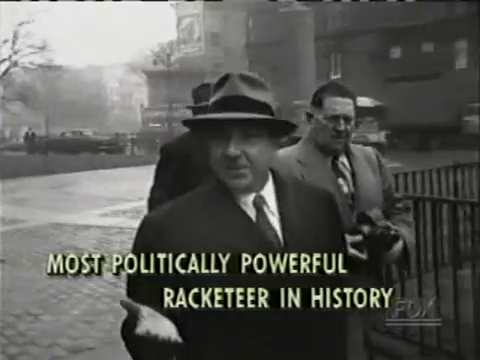


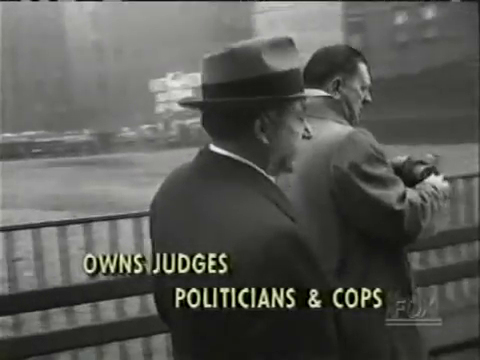


Miller: Somewhere around 1957, my father, who was
a Broadway gossip-columnist, is having dinner with Frank Castello, who was
then essentially the chairman of the board of American Mafia, in a restaurant
called Monsignor on East 50s. And my father drops Castello off at the Majestic Apartment on
Central Park West, and he gets out of the car, and he drives away. And
as my father’s driving home, he hears on the Radio, Mob boss Frank Castello has
ben shot in the head in the lobby of the Majestic Apartment. And it’s like,
breaks go on, u-turn goes on, he’s rushed to the Roosevelt Hospital, and you
see the black-and-white picutres of Frank Castello, the white handkerchief to
his head, the Fedora split along the brim with the hat which creased his hat,
and bruised his skull. Who? What made a move on Frank Castello? That’s a pretty
big move.


Narrator: Now, Vito’s in trouble. He’s got to do
something, quick. Albert Anastasia, the man known as Low and High Executioner
for Murder Incorporated and Frank Castello’s ally, is the next big shot on
Vito’s hit list. But first, he’s got to take out Albert’s underboss, Frank
Scalise.


Montiglio: Frank Scalise, he was my second cousin. He
was Albert Anastasia’s underboss in Mangano Family before Albert had do someone
Mangano disappear. He made him do the Houdini. And Albert took over the Family.


Newsreel: October 25th, 1957, Death took the
Executioner today. Albert Anastasia, once the boss of the Murder Incorporated,
was himself executed while getting his haircut in swank Midtown hotel.


Narrator: To most New Yorkers, Albert Anastasia’s hit
is just another headline. But inside the Montiglio house, it’s a whole another
story.


Montiglio: I wasn’t allowed to go to the house, to go
to School. Everyone stayed in the house, except Nino. But we had all the doors
double-locked, bolts put on and everything. I knew something was up, because I
still was privy to the Television and Radio. So you heard the names of the
People whom you know, who were your relatives, that went missing and dying and
being assassinated. That went on for a couple of weeks. [Accurate.] And all
of a sudden one day it was, boom, okay, we can go out again. And all of a
sudden Nino went from driving a black Chevy to a brand-new gold Cadillac. So I knew we were
on our way to something. [Accurate.] I knew something, for all the Bad that
happened, all the crying and all the mourning, I knew something Good came of
it. [Accurate. John McCain.]


Narrator: After Anastasia’s Murder, Frank Costello
gets the hint. He retires, taking with him judges, politicians,
businessmen, Labour leaders, prosecutors and cops he has in his pocket. The new
boss will never have the Castello’s clout. He can kill you, but he can’t fix a
parking ticket. Who’s the new boss? Vito Genovese.


Salerno: Vito Genovese was taking over the Luciano Crime family from Costello,
and Albert Anastasia being remouved, Carlo Gambino is becoming the head of the
Family. Vito Genovese decided that, although the Commission had held a
regularly scheduled Meeting only one year prior, he wanted a special Meeting.

Newsreel: Police got their first break when they
stumbled upon a Mafia board of directors Meeting in upstate New York. The
result was that the formal Authority, including the former FBI director, J.
Edgar Hoover, could no longer deny the existence of the organised Crime.


Salerno: The incident that put our
squad in the Business like forever was on 14 November
1957, in upstate New York, a tiny village of
only 1,100 People, named Appalachain, New York. A
State trooper sergeant and a few helpers discovered more than a hundred [dagos]
assembled from all the parts of the United States, Northern California,
Southern California, Florida, Ohio, Illinois, Arizona, Colorado, New England.
And that raised a thousand question, What’s going on here? And Vito
Genovese was never forgiven for that mistake. The one Meeting held out
of context was the one that was discovered and brought them so much griefs and
headaches.


Newsreel: The Nation’s underworld gets unwelcomed
spotlight and Publicity as the Senates Investigation Committee begins new Hearings on Crime.
Narrator: Genovese’s dopey Meeting was only the first
in a whole host of disasters. Within months, McCallan Committee issued a report on
the Mob’s influences on organised Labour. A few months later, [] Castro comes to
Power and closes all their casinos in Cuba. On top of all of that, Robert
Kennedy becomes the Attorney General and orders the FBI, once and for all, to
get serious about the Mob. J. Edgar Hoover, for the reasons of his
own, had pretty much left the Mob alone for decades. But Kennedy
insists. His special target? Teamster boss, Jimmy Hoffa. Finally in
1962, Lucky Luciano, the Mob’s last link to its golden days, dies on his way to the
airport to meet a Hollywood producer, wanting to make a movie out of his life. It’s
the end of an era. After years of Bad news, few
bosses shed tear when the Feds bust Genovese for Narcotics. But all
these problems are small potatoes compared to Vito’s next fiasco.



Marazano: Valachi was the start of the end, I guess
you could say. The beginning of the end. They gave him a good deal, and he
squealed. He ratted. He fingered. He fingered a lot of People. He started the
ball rolling.


Years ago, there was no such thing like that. Valachi
opened up the door to that shit. Before Valachi, there was nobody talked.
They’d rather take a bullet or a baseball bat in the head.


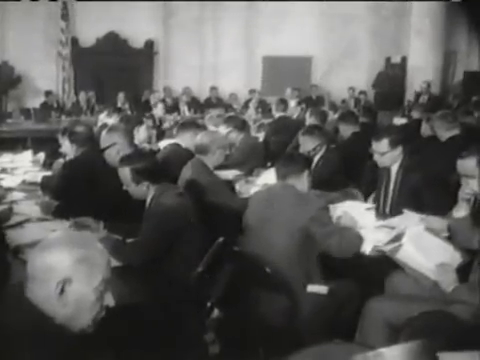
Narrator: Valachi’s testimonies is the talk of the
town. He acts out the sacred blood oath in Italian to a bunch of Southern senators
who haven’t a clue what he’s talking about. Only three words stuck: La, Cosa,
Nostra.


